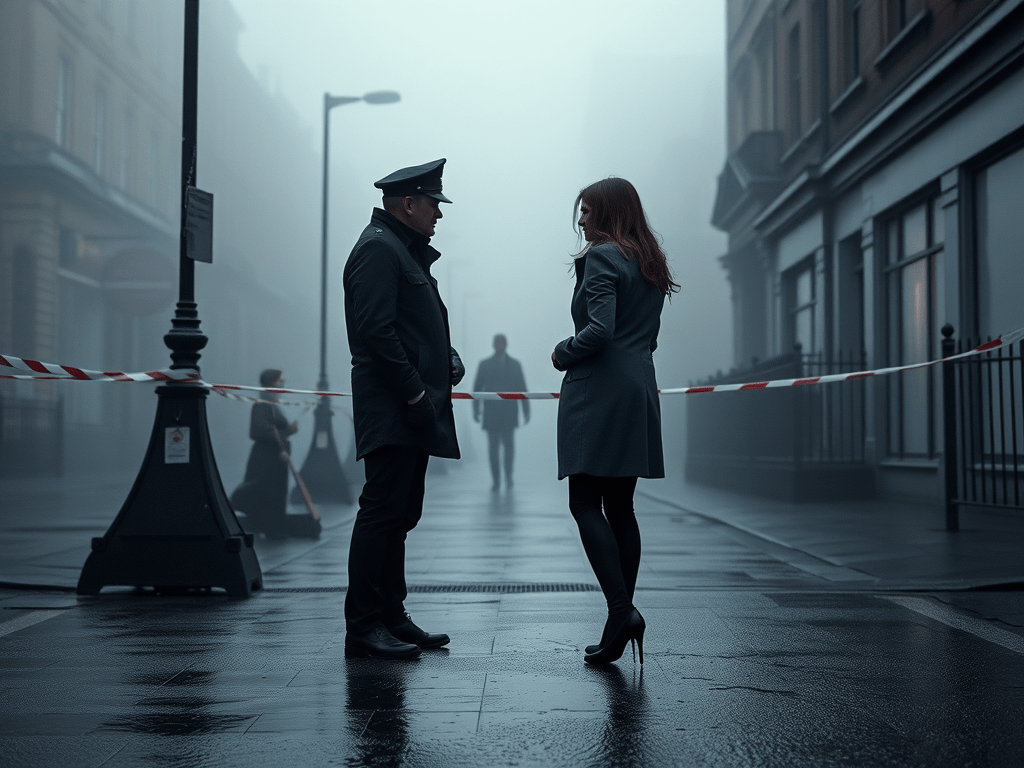
The finale of our first session.
If you have seen them yet, check out Part One and Part Two.
I hope you enjoy.
Evelyn Cross stepped into the tent, her expression composed and businesslike. She greeted the group with a polite nod, then asked John Miller and Father Mateo to remain behind. The others were asked to follow her.
She led them across the lot to one of the temporary office trailers. Inside, the space was cramped and plain, lit by buzzing fluorescent panels and filled with the smell of paper and dust. Desks had been arranged along the walls, and a few folding chairs were scattered around the center of the room.
Once they had all filed in, she explained their role. Their assignment was to begin sorting the documents that had been salvaged and placed in the white tent. The building itself was still too damaged and unstable to access fully, and much of it remained an active crime scene. Their work, she said, was part of the process of reclaiming the space. They were cleaning their way back in, piece by piece.
They were to organize the contents of the boxes by date wherever possible. Most of the materials were reports, correspondence, or administrative paperwork, much of it in rough shape. The goal was to bring order to the mess and prepare it for proper archival.
She pointed out the supplies. There were folders, paperclips, pens, sticky notes, labels, and index cards. A manual typewriter sat on a side table, along with a tall stack of paper. Beside it rested a portable tape recorder. Evelyn gave a quiet apology for the outdated equipment. Most of the electronics inside the Institute were either gone or no longer operable.
They were expected to write reports detailing what they had sorted, how they had grouped it, and any relevant information. Audio notes were acceptable if written reports were impractical.
Any materials recovered from inside the building would first go to the police. If the items were cleared and determined not to be evidence, they would then be released into the Institute’s care and added to the team’s workload.
Once they had established a working system, the organized records were to be transferred to two individuals: Professor Lionel Haversham, head of the archives, and Inspector Callum Briggs, head of research.
Evelyn’s tone remained steady throughout, though there was a tiredness behind her eyes that she did not mention. When she was finished, she gave a small nod and stepped out, leaving the group to their task.
Evelyn returned to the white tent to retrieve John Miller and escorted him across the lot to a separate trailer. She told Father Mateo to wait where he was.
The trailer she brought John to was smaller than the rest. A crooked paper sign reading Medical and Welfare was taped to the door.
Inside, Dr. Aisha Malik stood waiting. She greeted John with a warm smile and a voice that held quiet compassion. There was a steadiness to her, the kind that did not need to be loud to be trusted.
She handed him a large, empty medical duffel bag. It sagged open at his side as she began helping him fill it with the supplies she had on hand. Bandages, gauze, electrolyte packets, gloves, scissors, antiseptic wipes. Some of it was standard. Some of it looked borrowed from several different kits.
Dr. Malik explained his role with simple clarity. Until further instruction, his job was to assist the team. Lift what needed lifting. Make sure everyone stayed hydrated. Patch up paper cuts and minor strains. Be useful in the quiet ways that kept people going.
Once John was settled, Evelyn left the trailer and returned to collect Father Mateo. She brought him to another trailer farther down, marked for Archives and Storage.
Inside was Calliope Drennan, who introduced herself as Callie.
She was tall, striking, with copper red hair woven into elaborate braids. Her gloved hands rested lightly against the edge of the desk, and her posture was still as sculpture. She watched him closely as she spoke.
She explained that the artifact storage area in the Institute’s basement was currently inaccessible. The entrance hallway had collapsed. She showed him the photographs. Shattered beams. Caved-in brick. The path buried under debris.
Until the way was cleared, his assignment would be to review the materials the others managed to organize. As they brought order to the salvaged records, he was to look for any references to artifacts, or any patterns that might suggest connections. If he found something, it was to be brought to her directly before it reached the archives or research.
She paused, then asked the question without judgment.
“What brings a priest to work in a place like this?”
Mateo’s response was quiet. “I found myself at an intersection in my life. I thought maybe I could find some spark of the divine among these things.”
Callie’s expression barely shifted, but her eyes seemed to focus more sharply.
“That may come to pass,” she said. “But be wary of intersections. Look both ways before you cross them.”
They returned to the white tent and began the long process of carrying materials over to the trailer where they would be working. Boxes, folders, and loose stacks of paper passed between them, the wet air curling around each trip across the lot.
Inside the trailer, tension simmered just beneath the surface. Eleanor, Cass, Olivia, and Allie each came from adjacent disciplines. Administration, archives, research, analysis. Each of them had strong opinions on how the job should be done, and none of them seemed particularly eager to follow someone else’s lead.
The air was civil, but clipped. Glances were sharp, and the rhythm of conversation held just enough edge to be noticed.
It was Allie who managed to cut through the static. She laid out a plan, one that was clear, practical, and efficient. It struck the right balance between structure and flexibility, and for a while, the group began to move more smoothly. The tension did not vanish, but it quieted.
At some point, Professor Lionel Haversham entered the trailer without a word. He did not greet them or ask questions. He simply looked around, selected a seemingly random stack of papers, and walked out again, carrying the bundle under one arm.
John and Mateo, both watching from across the room, exchanged a glance. The moment felt strange. Deliberate, but without explanation.
Curiosity piqued, they stepped outside to follow him.
As they exited the trailer, they heard raised voices nearby. Two officers stood by one of the vans, the argument already underway.
The sergeant was shouting. “Then go home. If you’re not going to do your job, don’t expect to be paid for the week.”
The younger officer stood rigid, his face pale. “I’m not touching anything from that place. I’m not going in that building. I know what happens to people who get involved with this.”
The sergeant stepped closer, face tight with anger.
The officer’s voice wavered but held. “Alice and Bashira worked with the Institute. They’re missing. Nobody’s saying it, but we all know. I like my skin where it is, and I don’t plan on joining them.”
The sergeant snapped. “Then go the fuck home. We don’t need you if you’re going to be useless.”
He turned and stormed off down the street.
Allie had followed them out and caught up with the officer as he stood watching his superior disappear into the mist. She approached carefully, speaking low, and asked what he meant. What was really going on.
He hesitated, but eventually gave in.
He told her about Section 31. Not in detail, but enough. Enough to make it clear he was scared. Nothing good ever came from the police getting involved with the Institute. Every time they did, someone disappeared, or something worse.
He glanced at the badge clipped to her coat. “You work there now?”
Allie nodded.
“If you want advice,” he said, “run. Get out while you can. Don’t stick around.”
And with that, he walked off into the fog, leaving her standing alone in the pale light of the morning.
John and Father Mateo made their way toward the office trailer where Professor Lionel Haversham and Calliope Drennan were working.
Father Mateo entered first. He stepped inside and, with a kind of hesitant purpose, approached the professor. He attempted to ask what the papers were, and why Lionel had come into their trailer and taken them.
The question came out clumsy. The words tangled. His tone was off.
Lionel narrowed his eyes. “Why are you asking about that?”
Calliope turned from her desk. “Didn’t you already have an assignment?” she asked. “Something to keep you busy?”
While Mateo struggled to recover, John had been circling the outside of the trailer, trying to peer through the window. He quickly realized that from ground level, he could not see much of anything on Lionel’s desk. The window sat just too high, and the fog did not help.
So he found a folding chair and stood on it, hoping to get a better angle.
The condensation on the glass blurred the details inside. The writing was small. John squinted, adjusted his stance, leaned closer.
He slipped.
There was a thud as his shoulder hit the siding. His face struck the window, leaving a clear imprint on the glass.
Inside, Lionel and Calliope both flinched.
John, thinking fast, dropped down and pulled the chair under the trailer with him just before the door flew open.
Mateo stepped forward quickly. “Would you mind praying with me?” he asked.
Lionel and Calliope exchanged a look.
“Another time,” Calliope said flatly. “We will speak with you later. This is not over.”
They stepped out of the trailer and looked around, scanning the lot for the source of the noise.
John, now crawling on hands and knees under the trailer, had already slipped out the opposite side with the chair in tow.
They did not see him.
Mateo, still standing nearby, tried to draw their attention elsewhere. He pointed upward. “Do you see that? That almost looks like Saint Germain?”
Calliope followed his gaze to the window, now fogged over with the faint, unmistakable imprint of a human face.
She raised a brow. “This is not a case of Jesus’ face on a piece of toast. That looks like John Miller’s profile.”
Her voice sharpened. “What are you two up to?”
She turned on her heel and stormed off, Lionel close behind, both of them heading straight for the other trailer.
They entered with clipped movements, eyes sweeping the space.
“Where is he?” Calliope asked.
Lionel did not speak, but the weight of his silence was just as pointed.
Their frustration was evident. The air inside the trailer shifted, the quiet tension of the earlier work now replaced by a sharper energy.
Before anyone else could speak, Allie stepped forward. She met their gaze with practiced calm and asked for a moment to speak.
Her voice was steady. Reasoned. She explained that it was their first day, that tensions were high, that the situation surrounding the Institute was far from ordinary. Strange things had happened. Stranger things were still unfolding. They were trying their best to stay grounded in the middle of it.
“This is not about disrespect,” she said. “It’s just nerves. Confusion. People trying to do what they think is right, in a place that has not felt right since the moment we arrived.”
Her tone held just the right balance of humility and truth.
Calliope studied her for a long moment. Then gave a tight nod.
“We will chalk it up to first day mistakes,” she said. “But there will not be a second day like this.”
With that, she and Lionel stepped back out into the fog.
While all that was going on, the rest of the team continued their sorting and investigation inside the trailer. Eleanor and Olivia were making solid progress. Their systems were different but effective, and both women worked with quiet precision.
Cass, on the other hand, was having a much harder time. She fumbled a stack of papers onto the floor, then spilled her coffee as she reached to gather them. When she bent down, the corner of the table caught on her pocket, and the fabric tore just enough to sting her pride. Nothing catastrophic, but enough to sour her mood.
As she stood, flustered, her eyes met Eleanor’s again. The same flash of resentment passed between them. That same quiet hate, now tinged with embarrassment.
Jean Danko worked steadily alongside them. He noticed the subtle competition unfolding between Eleanor and Olivia and offered a new organizational method that neither of them had considered. It complemented both their systems, and his improvements actually made their work more efficient.
For a time, the trailer was quiet and productive.
Then came the loud banging at the door.
Allie opened it to find a police officer standing outside. He looked tired and slightly annoyed.
“Hey. The stuff we’ve cleared from evidence is piling up. Y’all need to come and get it.”
They followed him to the police tent.
Strangely, the area was empty. No officers inside. No voices. Just tables, rows of boxes, and the low hum of fluorescent lights.
John Miller moved toward the evidence tables. Boxes were stacked neatly, each filled with bags of labeled items, paperwork, and sealed containers. On the far side of the tent stood a corkboard mounted behind one of the tables. Photographs were pinned to it. Bits of yarn connected faces and rooms and fragments of text.
John approached slowly. His eyes scanned the images. One face stood out.
A tall, lanky man. Something about him felt familiar.
He stepped closer, took out his phone, and snapped a picture of the photo. The name written beneath it stopped him cold.
Timothy Stoker.
One of the Institute’s missing employees. And the man from the end of his dream the night before.
Elsewhere in the tent, the others quietly followed their own threads.
Father Mateo paused over a series of photographs taken behind the Institute. In one, a makeshift bed could be seen, tucked behind a dumpster—layers of cardboard and old fabric. Someone had been sleeping there.
Another set of photos showed bloodstains, beginning inside the front entryway and continuing out toward the doors. The doorframe had since been repaired, but the images captured it in its damaged state. The marks made it clear. Either someone had dragged themselves out, or someone had been dragged.
Other photographs revealed strange scratches on interior walls, in hallways and stairwells. The team followed the trail of claw marks with growing unease. They were fresh. Part of the chaos that still lingered inside.
One image showed the claw marks cutting directly across the broken doorframe, as if something had passed through it—forceful, deliberate, and far too large to be human.
No one said what they were thinking. They shook it off.
They gathered the boxes cleared from evidence and returned to the trailer to begin reviewing what they had been given.
As they settled back into work, John’s phone buzzed.
He checked the screen.
A new message.
I like your shirt. I wonder how it would look on me.
He blinked. Stared at it for a second. Then replied, half-joking.
That’s not how that line works. It’s supposed to be, it would look better on the floor next to my bed. Right?
He set the phone down. The screen lit up again almost immediately.
Well, there is more than one way to get into a man’s pants.
John didn’t reply.
He stared at the message. A cold unease slid beneath his skin.
He did not know who was texting him. But something about it felt wrong.
That was where the session ended.
 Mason Beck Fiction
Leave a comment