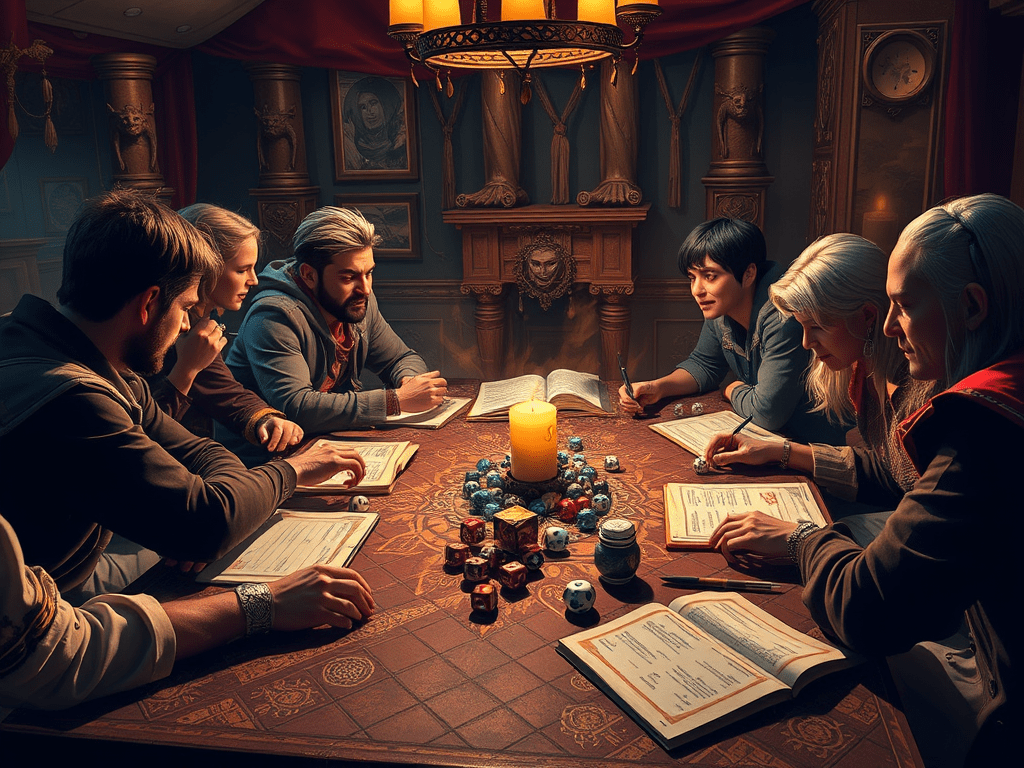
Loving the Game, Not the Grind
I’ve always loved a good crunchy system. There is something satisfying about sitting down with a blank character sheet and letting the possibilities open up. Building a character from nothing, weaving abilities together, finding the perfect combination of stats, it scratches the same part of the brain as a puzzle well solved. It is fun. It is exciting. And I won’t pretend otherwise.
But that spark fades the moment the game hits the table.
All that beautiful complexity, the weighty decisions and clever synergies, starts dragging its feet the second combat begins. The story slows. The mood thins. People check their phones. Someone sighs while they count modifiers. Someone else waits fifteen minutes to roll a single die. The excitement that lived so vividly in character creation quietly drains out between turns.
Complexity is fun when you are building a person.
It is far less fun when it keeps that person from living in the story.
My priority, always, is the story. The pulse of a scene. The breath between two characters who are not sure if they are going to make it out alive. The expression on someone’s face when the dice land and the moment hits just right. I want my players to feel something, in and out of combat. What I do not want is boredom masquerading as strategy. I do not want the table stalling while someone digs through a book, or the rhythm breaking because a ruling needs ten minutes of negotiation, or the tension bleeding away while we hunt for the right paragraph on the right page. I do not want long pauses where the mood goes flat and everyone goes quiet for the wrong reasons.
I love the game.
I just do not love the grind.
That is the line I drew for myself. And that is why Cypher pulled me in.
The Problem with Traditional Systems
I grew up loving the grand worlds that many traditional systems built. Their myths, their creatures, their histories, all of it lodged itself somewhere permanent in my imagination. But the mechanics beneath those worlds have always felt heavier than the stories they are meant to carry.
Certain problems stand out immediately.
Armor and defenses rely on abstractions that rarely feel intuitive in play. They work on paper but do not always make sense in the moment. Abilities and techniques are written to account for every possible contingency, so each one becomes a list of caveats and exceptions that slow the table down. When a scene halts because someone has to dig through a book, search for an errata entry, or scroll through an author’s social media post to clarify a ruling, all of the tension leaks away. The immersion breaks, not because the players lost interest, but because the rules demanded attention.
Combat often becomes a rigid sequence of turns instead of a living moment. Strictly rationed reactions and an inflexible structure create a rhythm that feels more like a board game than a fight. Defensive choices are reduced to static values instead of active decisions. And even as characters grow stronger, their actions remain defined by a handful of limited use abilities that never grow with their potential. You advance, but you do not truly expand.
Progression also comes in sudden jumps rather than lived increments. Long stretches pass with no meaningful change, followed by a single large block of improvements. There is no sense of getting better through small, earned moments. You simply endure the long march until the next level finally arrives. Even worse, health and performance remain identical until the instant a character drops. Someone clinging to their last point of life fights with the same efficiency as someone at full strength. The illusion of danger becomes exactly that, an illusion.
Even critical success can feel strange. A lucky roll may deal less damage than an ordinary one. The excitement rises for a moment and then deflates under the weight of technicalities.
I still enjoy those worlds. I still sit at those tables. But when it comes to running my own games, I want a system that moves with the story instead of slowing it down. A system that keeps the focus on the players, not the rulebook. Something that breathes.
The Pacing Problem
Table time is precious. Most of us are adults with jobs, families, responsibilities, and only a sliver of the week carved out to gather around the table. When that time is lost to rule lookups, arguments over edge cases, or the slow churn of a complicated encounter, it is gone for good.
A four hour session with a traditional system can disappear into a handful of rounds bogged down by math, adjudication, and procedural steps. A fight meant to last ten minutes stretches across the entire night. If the battle is particularly complex, it can swallow a full month of weekly sessions before the story can move forward again.
In moments like that, the rules become the main event, and the narrative is forced to wait its turn. Even the richest settings and the strongest character arcs vanish beneath the weight of technical play.
I want my games to keep moving. I want them to breathe. I want the story to stay alive from the first roll to the last.
Enter the Cypher System
The Philosophy of Flexibility
Where many traditional systems try to write a rule for every possible situation, Cypher takes a quieter, more open approach. It gives you a framework and trusts you to use it. Instead of memorizing restrictions, the focus becomes describing what you want to do and letting the table build from that intention.
If a player wants to grapple someone and they happen to have a tarp in their inventory, they can simply ask if throwing the tarp over the target would give them an asset on the attempt. The answer is usually yes. There is no need to search through a rulebook or argue over whether a specific provision applies. You use what you brought, what the world offers, and what makes sense in the moment.
If there is loose gravel, you can kick it into an attacker’s eyes. If there is a rain-slick street, you can try to slide under a strike. If you are in a cramped kitchen, you can slam a cupboard door into someone’s shoulder. The environment opens itself to you, and the mechanics support that freedom instead of resisting it.
Creativity is not a loophole in Cypher. It is the intended mode of play.
Cypher approaches progression differently. Growth happens steadily, through choices the players make every time they earn experience. Instead of waiting for an enormous leap, characters advance in small, intentional steps. They can spend their experience on short term benefits that immediately influence a scene, or long term benefits that shape who they are becoming. Each decision feels tangible because it changes the way the character interacts with the world right away.
As players continue to invest those points, they move closer to the next tier. It feels like climbing a staircase rather than struggling up a cliff. You know you are getting somewhere because the improvements are happening as you go. You gain skills, expand your capabilities, refine your defenses, sharpen your specialties. By the time you reach the next tier, you can see the trail behind you and understand how you got there.
Progress becomes part of the narrative rather than something that happens offscreen. Characters do not simply wake up stronger. They become stronger through the choices they make and the challenges they survive. It builds a sense of momentum that traditional systems rarely achieve, and it keeps the players engaged because their decisions matter every single time experience touches the table.
Streamlined, Not Simplistic
Cypher is not minimal. It is not a half-formed system meant only for quick sessions or new players. It has a solid foundation, clear mechanics, and enough structure to support long-term campaigns. What it avoids are the heavy layers that bog down the flow of play. The result is a system that feels light without feeling thin.
The core is easy to learn. From there, you choose the level of complexity you want. You can keep the game story-driven and cinematic, or you can add optional rules, new mechanics, and custom subsystems as they fit your table. The framework is strong enough to grow without breaking. It also has no rigid classes, subclasses, or enforced roles. Archetypes exist if you want a general shape to follow, but you can build your character however you want, drawing strengths and abilities from anywhere that fits the concept instead of being confined to a predefined mold.
Several strengths stand out clearly.
Armor actually reduces damage in a way that matches the fiction. Initiative is simple enough to encourage genuine teamwork and shared planning. And because the GM never rolls, the game stays centered on the players. They make the attacks. They defend themselves. They are never pieces on a board waiting for something to happen to them. Every roll is theirs, and so is the responsibility that comes with it.
The system molds itself to the people playing it, not the other way around. It stays focused on what matters most, the table and the story unfolding across it.
Evolving the Core
Cypher’s real strength lies in its openness. You can graft themes, systems, or emotional structures from anywhere, and they blend seamlessly because you are not converting rules, you are capturing intent. If you want creeping madness, you can pull in ideas inspired by cosmic horror and make the players feel the slow unraveling of certainty. If you want a morality struggle that tracks the erosion of humanity, you can weave that into character arcs without forcing everyone to learn a new subsystem. If you want danger to feel sharp, immediate, and consequential, you can create a sense of edge or risk without rebuilding the engine that carries the story.
It is a system that listens to the story you want to tell. It lets you borrow concepts from anywhere, strip them down to their emotional core, and fold them into the moment you are crafting at the table. You do not have to mimic someone else’s rules to recreate their genre. You only need to understand the feeling you want the players to experience, and Cypher gives you the room to pursue that feeling directly.
You can build a corruption track for a cursed artifact. You can create a trust meter between characters. You can structure investigations through clue tiers or symbolic milestones. You can give monsters narrative weight through simple GM intrusions instead of pages of mechanics. Nothing fights against you. Nothing forces a particular shape. The system bends toward the tone you set.
Cypher never asks you to replicate another game. It asks what emotion you want to evoke. What tension you want to heighten. What pressure you want the scene to carry. Once you know that, the mechanics take a step back and let the mood settle into place.
Everything folds easily into the framework because the framework is designed to welcome it rather than resist it. Cypher makes space for your ideas, not the other way around.
A History of Systems
My first foray into tabletop roleplaying was through Vampire The Masquerade and Shadowrun, and eventually the rest of the old World of Darkness. Those games taught me atmosphere, consequence, and the weight of personal stakes. They also taught me that mechanics can either open a story or fence it in.
Mage The Ascension left the deepest impression. Its magic system was wide open, philosophical, and endlessly interpretive. You shaped reality not through spell slots or predefined effects but through intent, belief, and the consequences of bending the world to match them. Even then, long before I knew what Cypher was, I found myself drawn to systems that let the narrative breathe rather than bottling it up.
Later, I drifted into the worlds of D&D, Pathfinder, and other mainstream fantasy frameworks. Each one opened into entire universes of lore, settings layered with history, cultures, pantheons, monsters, and more content than a single lifetime could ever fully explore. They were rich in ways few other franchises even attempt to be. You could spend years reading their novels, studying their maps, paging through their bestiaries, and still feel as though you had only touched the surface. I have always loved that part of them. I still do. Those books are some of the most imaginative works in the hobby, and they inspired countless ideas of my own long before I ever sat down behind a GM screen.
I enjoyed diving into those worlds, learning their histories, following the storylines of their great conflicts, and discovering the small, strange corners that only reveal themselves when you go looking for them. Their creativity is undeniable. Their breadth is unmatched. When I say I admire them, I mean it in the most literal sense. They have shaped the way I think about fantasy, adventure, and worldbuilding.
But as much as I cherished the settings and the characters you could build within them, the machinery underneath always felt heavier than it needed to be for the kinds of stories I wanted to tell. The lore spoke to me. The mechanics never quite did.
GURPS has remained one of my favorite toolboxes. It is not overly complicated, just lacking the right feel when it actually hits the table. What it does offer, though, is a breadth of ideas and customization that no other system has truly matched. Its books are still some of the best sources of inspiration you can find. I keep buying them because they spark concepts no other system quite reaches.
Cortex Prime came close to what I wanted, especially with its plot points and its flexibility. It is an elegant design, but still a little heavier than it needs to be for the kind of games I run. Cypher achieves the same narrative control by letting players spend experience for player intrusions, and it does so with far less overhead.
All of these systems taught me something. They showed me that you can love the craft of design, admire the structure, and appreciate the cleverness, yet still not want to play inside those boundaries.
Cypher offers the part I was always looking for. The imagination is there. The options are there. But the inertia is gone. It moves the way my stories move, and it keeps the table where I want it, inside the moment rather than outside the mechanics.
Conclusion, The Story Always Wins
Cypher does not tell you how to play. It gives you room to create. It hands you the tools and trusts you to build the story you want without getting in your way.
The other worlds I have played in over the years are still important to me. I still buy the books, still read their lore, and still enjoy the artistry and imagination behind them. I think anyone who loves this hobby should explore them. Their settings, their ideas, and even their odd little corners of design are worth the time. I continue to incorporate their concepts into my own games, and every now and then a mechanic is so clever or evocative that I bring that along as well.
But for the mechanics themselves, I have learned what fits my table best. I still love running and playing in those classic systems. I still sit down for them and will continue to do so. For me, though, the Cypher System carries the story with less friction. It clears the space so the narrative can breathe and the players can live inside the moment instead of around the math.
Cypher steps aside so the story can speak, and at my table, that is all I ever wanted.
 Mason Beck Fiction
Leave a comment