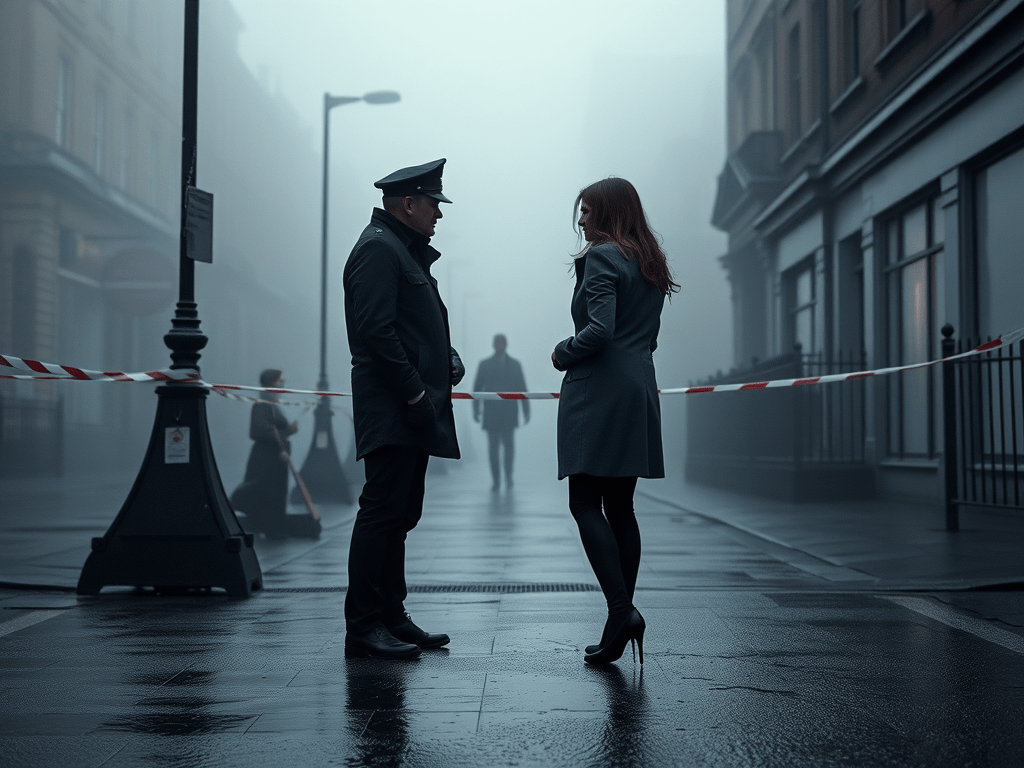
Session Two was a lot of fun and, while a little janky, the transcription bot worked so I was able to capture as much as possible.
I hope you enjoy.
The morning of November 17th, 2025, had been a trial by fire, sometimes literally, given the state of the Institute. The new staff had stumbled through their first hours, navigating chaos and suspicion in equal measure. They had eavesdropped on arguments, snooped through evidence, and narrowly avoided the wrath of department heads. Now, as the afternoon stretched before them, they found themselves back in their cramped trailer office, the weight of the day settling into their bones.
John Miller sat staring at his phone, a strange expression on his face. The others watched him.
The messages he’d received were unsettling. Flirtatious in a way that felt wrong. Invasive. He set the phone aside and turned his attention to the work at hand, determined not to cause any more trouble than he already had.
Father Mateo cleared his throat, holding up a photograph he’d kept from their brief excursion into the police tent.
“See this?” he said, tapping the image. “In the photograph, behind the dumpster. There’s cardboard, newspapers, a bundle of belongings. Someone was sleeping out there. A vagrant, perhaps. They might have seen what happened.”
Eleanor McKenna studied the photo for a moment. Without a word, she stood.
“I’m going to check the alley,” she announced.
Olivia Schmidt rose to follow. John, who had stepped outside moments earlier to smoke and settle his nerves, noticed them heading toward the rear of the building and trailed at a distance. Not to interfere, just to keep watch.
The three made their way around the back of the Institute, badges visible on their lanyards. An officer at the rear barricade gave them a cursory glance, then returned to his phone.
The alley was narrow and damp, shared by the Institute and the buildings on the adjacent streets. A dumpster sat against the back wall, and behind it, partially hidden from casual view, lay what they were looking for.
Eleanor moved carefully, using her careful observation skills. She found the makeshift bed: cardboard layered over concrete, old newspapers crumpled for insulation. Beside it lay a small, weather-beaten backpack.
She pulled it out and began going through the contents. Toiletries. A toothbrush. A hairbrush. The essentials of someone with no permanent address. No identification. No name written anywhere.
But as she disturbed the pile, something fluttered loose. A torn scrap of paper, damp and creased.
A flyer. Partial, but legible.
Mission of Saint Augustine Church. Soup kitchen. Shelter. Limited beds available.
Eleanor pocketed the paper and took a photograph with her phone.
As the two women turned to head back, they found John leaning against the wall, cigarette smoldering between his fingers, a shit-eating grin on his face.
“Find anything interesting?” he asked. “Didn’t realize snooping through other people’s things was part of the job description.”
Eleanor gave him a flat look. “I thought this was our job. To find out what happened.”
John’s grin didn’t falter. “Mine’s just to make sure you don’t get hurt.” He glanced at the backpack, then back at her. “A paper cut, I guess.”
He turned and started walking back. Eleanor and Olivia followed, Olivia carrying the backpack.
Back in the trailer, they shared their findings with the others. Father Mateo examined the flyer with interest.
“Saint Augustine’s,” he said. “I’ve heard of this mission. They do good work: soup kitchen, shelter beds, confession services. I’d like to come along if we go to return these belongings. Perhaps I can help with the soup kitchen, read some verses. Do some good.”
Olivia nodded. “We should return the backpack to its owner. See if we can locate them. Get more information.”
Eleanor considered. “We could check if the person is there first. If they’re not, we give it to the police.”
“After work,” John added. “I’ll buy you all that drink I owe, and we can go from there.”
The trailer door flew open.
Oliver Dent, the nervous receptionist, stumbled inside, slammed the door behind him, pressed his forehead against it, and took a deep, shuddering breath.
Olivia raised an eyebrow. “Are you okay?”
Oliver spun around, eyes wide. “Oh my god. I am so sorry. I forgot you all started today.” He ran a hand through his already disheveled hair. “Forgive me. Please don’t tell anyone. But this trailer’s been empty all week, waiting for you lot. When things get overwhelming, I come in here. Just a minute or two. Deep breaths. Put the smile back on. Go out like nothing’s wrong.” He winced. “I forgot you were here.”
John stepped forward, his usual sardonic edge replaced by something warmer. “Look, mate. You’re alright. We all get overwhelmed sometimes. If you need to come in, have a seat, take a breath, that’s fine. We’re not going to tell anyone.”
Oliver’s shoulders sagged with relief. “I really appreciate that. If only there was time for a real break. But I need a breather, not a holiday.” He straightened his tie. “Now I have to order emergency catering for everyone’s lunch. Hope your first day is going well.”
He paused at the door, took one more deep breath, plastered a smile on his face, and stepped back out into the chaos.
John followed him outside, stopping just under the porch. Jean Dainko, feeling restless, slipped out as well and trailed the receptionist at a discreet distance.
Oliver approached one of the other trailers, the one that now bore the unfortunate silhouette of John Miller’s profile on its fogged window from earlier shenanigans. He knocked, entered, and Jean crept close enough to listen.
Through the thin walls, Jean heard Oliver rattling off restaurant names, asking about catering preferences. Standard administrative work. Then a new voice, one Jean recognized: Calliope Drennan, Head of Library and Artefact Storage.
“Wait a moment.”
“Yes, Miss Drennan? What can I help you with?”
“What do you think of the new arrivals? The new hires?”
“Haven’t made up my mind yet. I’ve only spoken with them for maybe a minute. Been run around quite a lot.”
“Do me a favor.”
“Yes?”
“Keep an eye on them. I’m not quite so sure we’ve made the best decision yet. I’m going to reserve judgment for a bit. Report back. Let me know if you see anything.”
“Yes, Miss Drennan. And I’ll see if they have your pickles wherever we order from.”
Footsteps approached the door. Jean ducked around the side of the trailer.
Oliver emerged, took another deep breath, muttered “Miss Drennan, perfect Miss Drennan,” and hurried off toward the investigation vans, chasing someone with a manila folder.
Meanwhile, John had been keeping watch. His gaze swept the area, noting patterns emerging from the chaos.
There was a police officer who was supposed to be guarding the evidence tent. Fidgety. He kept coming in, looking around, and walking back out. He hovered near the mobile investigation van rather than staying with the evidence.
And across the street, on one of the old buildings, a law office called Whitmore & Hale, John noticed a security camera. It swept back and forth on its own, but when an older woman walked by with a tiny dog, the camera tracked her until she was out of range, then resumed its regular pattern.
Jean returned, looking slightly embarrassed at having been caught snooping.
John gave him a grin. “Interesting place, isn’t it?”
Jean nodded. “They don’t seem to trust us yet. We should watch our backs.”
Inside the trailer, John clapped his hands together.
“So. Something interesting. That sad security guard, for one, he’s fidgety. Why’s he so interested in that mobile van? Two, I wonder what they have in there and if we can get a look. And three,” He pointed toward the street. “There’s a camera across the way on the law offices. I wonder if they have footage from when all this happened. Or footage of our vagrant friend.”
Olivia frowned. “It doesn’t make sense that the police had that photograph and didn’t find the bag themselves. They combed through the whole place, but somehow missed the flyer?”
“They know more than they’re telling,” John said. “And if they’re holding back pieces of the puzzle, we need to find them ourselves.”
The opportunity came soon after. The fidgety officer brought another box into the blue tent, then stepped out for a cigarette. John watched him settle between two storage containers, arms wrapped around himself against the cold.
“You smoke?” John asked Olivia.
She considered. “Social smoker.”
“Think you can keep him distracted for ten, fifteen minutes? Buy me some time?”
Olivia nodded and headed toward the officer.
She approached casually, asking to bum a cigarette. The officer turned, and the moment he saw her face, the burn scar, the handprint branded across her mouth, he froze. The cigarette hung in midair between them.
“Here you go,” he managed.
She took it, unfazed. “Would you mind a light?”
He produced a plasma lighter. “These are better for crime scenes. Can’t rely on a real flame in all this wet.”
The small talk was awkward. He kept glancing at her scar, then away. Classic discomfort. She’d seen it a thousand times.
When he started making excuses to leave, she cut him off. “Do you want to know what happened?”
That stopped him cold. She leaned in, her voice dropping. “Everybody wants to know. Nobody’s brave enough to ask. So, are you brave?”
He handed her another cigarette. “Alright. Tell me.”
Meanwhile, John, Eleanor, and Ally slipped into the blue tent. It was empty. Tables lined with boxes. Folders stacked high. Photos pinned to corkboards.
Eleanor moved quickly, her researcher’s eye picking up patterns. She found the organizational codes on the boxes, looked them up on her phone, and began to understand the system.
Medical and biological evidence was stored in a small freezer in the back, with a thick stack of folders on top. Video and photographic evidence was marked with specific codes. And near the top of one pile, a small DVD case. The label read:
Whitmore & Hale Solicitors – Security Footage.
The law offices across the street.
Eleanor pocketed it.
John found what he was looking for beneath a photo of Timothy Stoker, one of the missing staff, the man from his dream. A folder with the man’s name on it. He had Eleanor photograph its contents.
Ally discovered the biological evidence. Blood samples, preserved and labeled. The folders detailed a blood trail leading away from the Institute. The blood had been matched. It belonged to Basira, one of the officers who had been working at the Institute.
The pattern of the stain suggested she had been moving when she bled. Running, perhaps. Or dragged.
They gathered what information they could and slipped back out before the officer returned.
Lunch arrived. As they ate, a commotion outside drew their attention.
People were tidying frantically. Officers straightened their uniforms. Someone was arriving.
A shiny black town car rolled through the barricades, the first vehicle allowed through since they’d arrived. It stopped directly before the Institute steps. A driver in a smart blue suit emerged, walked to the rear passenger door, and opened it.
Dr. Miriam Caldwell stepped out.
Sharp-featured. Mid-fifties. Silver-streaked hair pulled into a severe bun, not a strand out of place. Tailored suit, immaculate. Five foot nothing, but somehow everyone around her seemed smaller.
This was the woman who had interviewed them. The Director of the Institute.
She retrieved an expensive leather attaché from the car, straightened her jacket, a gesture that was unnecessary but precise, and walked directly toward them.
They had all felt it during their interviews: despite needing a booster seat to see over a steering wheel, Miriam Caldwell had a way of making you feel like you were looking up at her.
“Good morning, all.”
Her gaze swept across them, piercing, assessing.
“How are you finding yourselves on your first day?”
Ally spoke first. “Underwhelmed.”
Dr. Caldwell’s expression didn’t change. “How so?”
“It feels like we’re not being told what we need to be told.”
“Really? And what have you been told?”
“To go through things and organize them. That’s it.”
The Director’s eyes moved to John, who had positioned himself at the back of the group, spine rigid, avoiding her gaze in a way that suggested deep respect rather than evasion.
“Is that also your experience, Mr. Miller?”
“Ma’am, I have a different job than them. I find these intellectual tasks… not necessarily my area.”
“Don’t do yourself or this Institute a disservice, Mr. Miller. Don’t sell yourself short, and do not denigrate yourself to me. I wouldn’t have hired you if I didn’t think you were equipped for the job. Intellect or otherwise. Please answer the question.”
“I don’t necessarily agree with the underwhelming part. I’m confused, but I have a feeling that will be resolved the further we go.”
“Understood.”
She turned to Jean, who was trying to avoid her eyes. “Mr. Dainko?”
He looked at the ground. “It’s been interesting so far. I’ve been having fun.”
“Good. Even in unfortunate times such as this, finding a bright spot helps. Keep that attitude, and perhaps you’ll make it a bit further.”
She addressed Eleanor next, then Olivia. When her gaze fell on Olivia’s scarred face, something notable happened: her eyes never drifted to the mark. Not once. She looked directly into Olivia’s eyes and held there.
“Miss Schmidt. What is your impression?”
“It has been an interesting morning. I do feel like other higher-ups do not want us here, as if we are not qualified to do our jobs. But I have been attempting to make the best of it. I think we are making progress. Slowly. But we are making progress.”
Dr. Caldwell’s voice hardened slightly. “Let me make one thing very clear. This is not a democracy. Their opinions about you are irrelevant. I am the one who hired you. It is my opinion, and my opinion alone, that matters. Is that understood?”
“Yes, ma’am.”
Father Mateo stepped forward, taking her hand with both of his. “Doctor, it’s truly a pleasure. A tremendous opportunity, a tremendous honor. I couldn’t agree more. I don’t feel the heads of departments quite know what to do with us yet. But that is understandable, given the circumstances.”
“And I cannot entirely fault them,” Dr. Caldwell replied. “They are busy with their own focuses. However, I will make myself better understood regarding priorities. And those priorities involve
you.” She looked at Jean. “You had a question?”
Jean hesitated, then asked, “Why did you hire us? What stood out that made you think so highly of us?”
A small smile cracked the corner of her mouth. “Necessity, Mr. Dainko. Necessity.”
“Any other questions? No? Follow me.”
She led them into the Institute proper for the first time.
The reception area had been mostly cleared, but the damage was obvious. Claw marks led toward the door, long, deliberate gouges that seemed too large to be human. Down the halls, disaster stretched in both directions.
Through the employee-only doors, she showed them the lockers: cleaned, disinfected, their names already labeled. Showers and facilities. Everything they would need.
Then she led them to a stairwell and up to the second floor.
“For the remainder of the afternoon,” she said, “the priority is getting a path cleared. The police have been using curation services to handle the irrelevant debris. You will be doing a similar task, but with relevant information. We need to know what happened here. We need to know what the previous staff were working on, and whether it is connected to their disappearance. Is that understood?”
“Yes, ma’am.”
“The Research and Investigation department is through those double doors, up the stairs, and in the main area. Clear a path. Box things up. Put them aside. Don’t break your necks getting up there. The stairs are treacherous.”
She turned to leave.
“Hope to see you soon, ma’am,” someone called after her.
Without breaking stride, she lifted her hand with a small, queenly wave of acknowledgment and continued on her way.
The moment she was gone, John physically deflated. The tension in the room lightened. Everyone felt it. They had all been compressed in her presence.
Ally watched her go with something like admiration. “I hope to be like that woman someday.”
Eleanor gave her a look. “Careful.”
“I meant a leader.”
Jean rubbed the back of his forearm unconsciously. “She reminds me of my third-grade teacher.”
John stared at him. “What kind of fucking school did you go to?”
“You don’t want to know.”
Father Mateo nodded sagely. “Sister Ruth. Just like Sister Ruth back at the convent.”
John shook his head. “She reminds me of goddamn drill sergeants.” He started moving toward the stairs. “Let’s get to work.”
The Research and Investigation department was a disaster.
Tables overturned. Books scattered. Paper shredded and strewn across the floor. There was a faint smell of kerosene, and scorch marks where fires had started but been suppressed by the sprinkler system.
They worked. For two and a half hours, they cleared paths, boxed materials, and made the space navigable.
During a brief break, they checked their lockers. Jean found his already labeled with his name. Olivia opened hers and froze.
Beneath the sharp chemical scent of Clorox wipes, there was something else. Faint. Old. But unmistakable.
Her mother’s perfume.
A perfume that hadn’t been manufactured in years. A scent she hadn’t encountered since childhood. Since the fire.
She stood there, the locker door half-closed, breathing it in.
John, meanwhile, was arranging supplies when something fell from the top shelf. A piece of paper that had been tucked out of sight.
He picked it up. The handwriting was familiar.
It was his own.
“They do not come for you from the shadows. They will use the front door, and you will welcome them inside. Remember Irenie.”
He stared at it for a long moment, face unreadable. Then he folded it and slipped it into his pocket.
They returned to work, organizing the research materials, attempting to create a timeline. Eleanor and Jean found a rhythm, their systems complementing each other. Together, they powered through box after box.
And then Eleanor found it.
Based on all the dates they’d catalogued, based on the timeline of events leading to the Institute’s destruction, this was the most recent statement. The very last case the previous staff had been working on.
She read it aloud.
Statement of Eleanor Harper, September 14th, 2025
My name is Eleanor Harper. I work in internal accounting, senior specialist, with Larchmont Investment Group. One of those new glass towers downtown. Twenty-sixth floor, open-plan office, shared pods, the whole thing.
Six months ago, this was a Tuesday, I think, Daniel came in like he always did. On time. Coffee from the place downstairs. Same routine. Nothing about him seemed wrong at first. But once he settled at his desk, I noticed he kept looking over toward Sarah’s cubicle. Not in a creepy way. Not like he was watching her. More like he was checking something. He’d glance over, frown slightly, then look back at his screen. A few minutes later, he’d do it again, like he was trying to line something up in his head and couldn’t quite get it to match.
A few of us were standing by the coffee machine, waiting for it to finish brewing. Daniel was there with us. He’d been quiet all morning but not in a worrying way, just distracted. While we’re waiting, he frowned at the counter and almost casually said, “Where’s Sarah?”
We all kind of stopped. No one answered right away because none of us knew what he meant. Sarah was standing right there. She looked up, smiled a little, and said good morning, like she thought he was joking, or maybe had missed something. He looked at her, then at us, confused more than anything. Like he was trying to figure out if he’d walked into the middle of a joke.
He shook his head. “No,” he said, “that’s not her.” He pointed at Sarah, then looked at the rest of us. “You all see her,” he said, still calm. Still trying to reason it out. “But it’s not her. I know Sarah. That’s not her.”
Sarah just stood there for a few seconds, like someone was about to explain it. Daniel gave a nervous laugh and rubbed his face with both hands. “Okay,” he said slowly. “I’m missing something.” He looked back at Sarah, then to us again. “Is this a joke?” he said, careful. “It’s not funny anymore.”
Another pause. Too long. That’s when his voice started to rise. He kept pointing, first at Sarah, then at the rest of us. He said the joke wasn’t funny anymore. Said someone should have told him what was going on. Why Tim? By the end he wasn’t asking questions at all. He was accusing us.
Eventually security had to be called. By then Daniel was crying, not shouting anymore, just crying. They tried to calm him down, to get him to sit, but he wouldn’t stop looking back at us. Not angry. Just hurt. Like we’d betrayed him.
A little while later, an ambulance arrived and took him to the hospital. Last I heard, he was admitted to Greyfriars Psychiatric. At the time, we all told ourselves the same thing. Stress. Burnout. A breakdown. Daniel had always been quiet and tense, maybe, but kind.
A few weeks after that, Sarah didn’t come back from lunch. Her desk was cleared out the next day. A couple of weeks later, Marcus stopped showing up. After that, it was Anu. All at once. Gone one morning, no explanation. Tim was the last. That was months later. No notices, no goodbyes, just missing, like they’d never been there to begin with.
It started eating at me. I couldn’t get Daniel’s words out of my head. That’s not her. You all see her, but it’s not her. Every time someone didn’t come back, I kept hearing him say it again. Like he’d been trying to warn us.
So I went over to personnel. I used to do admin, years ago, before accounting. I still remembered where the old event binders were kept. Bottom cabinet, locked drawer. I had to wait until the front desk was empty. I pulled the binder for 2018. Christmas party. There was a photo inside. I knew all the names, they were written neatly on the back in black ink.
But when I looked at the photo, I didn’t know the faces. Half of them, maybe more, I’d never seen before in my life. And the names, those were people I’d worked with for years. The faces I did recognize belonged to the ones who’d vanished.
One of the names, she’s still there. I say hello to her every morning. But now I don’t know which one she is. I don’t know which face is supposed to be hers. I don’t think I ever did.
I didn’t take the photo. I left it where it was. I made sure nothing looked disturbed. I’m not stupid. I came here straight after work. I don’t want to lose my job. I need it. But I can’t pretend I didn’t see what I saw.
I’m scared that I might be next.
Please.
Please help.
Silence filled the trailer.
“That’s… intense,” John said.
Olivia nodded slowly. “We should look into this.”
Jean found additional notes in the file. Eleanor Harper had not left contact information, but the previous staff had done their own research. Martin Blackwood, one of the missing researchers, had confirmed that Harper was indeed employed at Larchmont Investment Group. A Daniel Moore was currently undergoing treatment at Greyfriars Psychiatric. And when the Institute had called Larchmont asking about their missing employees, they’d been told the staff had been “poached” by a competitor.
When the competitor was called, they had no record of any of those employees.
“People being replaced, one by one,” John said. “And now the staff who were looking into it are gone too.”
Jean spoke up. “We should take pictures of ourselves. Just in case we’re dealing with something that can replace people. Evidence that we are who we say we are.”
They did. Everyone’s photo, on everyone’s phone. Redundancy against the unknown.
“We still have those DVDs,” Eleanor said. “From the law offices. Security footage.”
They gathered around her laptop. The footage was dated. The last recording was from not long after the statement had been taken.
They watched. Fast-forwarding through empty night streets. The first person to arrive in the morning was Elias Bouchard, unlocking the Institute doors. Then Jonathan Sims. Martin Blackwood. Basira. Alice. Tim. Various other staff.
A little after 2 PM, a nervous young man appeared on screen, big bottle glasses, looking over his shoulder as if afraid of being followed. He checked both directions, then walked through the Institute’s front door.
Olivia’s heart stopped.
Her little brother. Oliver Schmidt.
He walked inside. And didn’t come out.
The footage continued. Around 4 PM, people stopped leaving the building. By 7 PM, the feed turned to static.
And then, a flash. A brief return of the image. The Institute’s front door opening. A hand grasping the door frame, pulling a body forward. A face.
Basira.
And then she was violently pulled back through the doorway. The door closed. Static resumed.
Final day. Contact lost. Magnus Institute.
“Jesus,” John breathed.
“She was a police officer,” he continued. “Basira. She must have fought hard. But there was more than one… whatever it was.”
“We know the blood outside belongs to Basira,” Ally said. “The pattern suggested she was in motion when she bled. Running, maybe. Or being dragged.”
Olivia frowned. “But there were no footprints. If someone else was moving her, there would be impressions. Blood on shoes. Something.”
John shook his head. “I’m not an investigator. You all handle this. That’s not how my brain works.”
His phone vibrated.
Another message.
“Have you been sleeping? I see you in my dreams too.”
John looked at the screen, unsettled but still playing along. He typed back:
“Well, if you see me in your dreams, you’d know how I sleep.” A winky face. A small smirk on his face.
The reply came almost immediately.
“Oh, I do. And I can’t wait to make your dreams come true.”
That’s when it hit him.
When they’d been clearing the path upstairs, when they’d stepped into one of the side rooms, everything had been thrown around, destroyed. Tables overturned. Shelves toppled. Chaos.
But he’d been there before. In his dreams. And in the dream, the shelves had been full of books. The chairs had been upright. Everything had been in its place.
He’d seen that room.
Before it was destroyed.
The color drained from John’s face. The smirk vanished. His eyes went wide, his mouth a straight line. Despite his typically darker complexion, he looked like he had seen a ghost and was about to vomit.
The others noticed the change. They watched him, waiting.
But whatever he was going to say, if he was going to say anything at all, would have to wait.
It was time to clock out.
Somewhere in the city, a church waited with answers. A vagrant who might have seen something. A psychiatric patient who knew that his coworkers had been replaced by things wearing their faces. And a brother who had walked into the Institute one afternoon and never walked out.
The mysteries were multiplying faster than answers.
And somewhere, someone was texting John Miller from dreams that shouldn’t be possible.
That was where the session ended.
 Mason Beck Fiction
Leave a comment