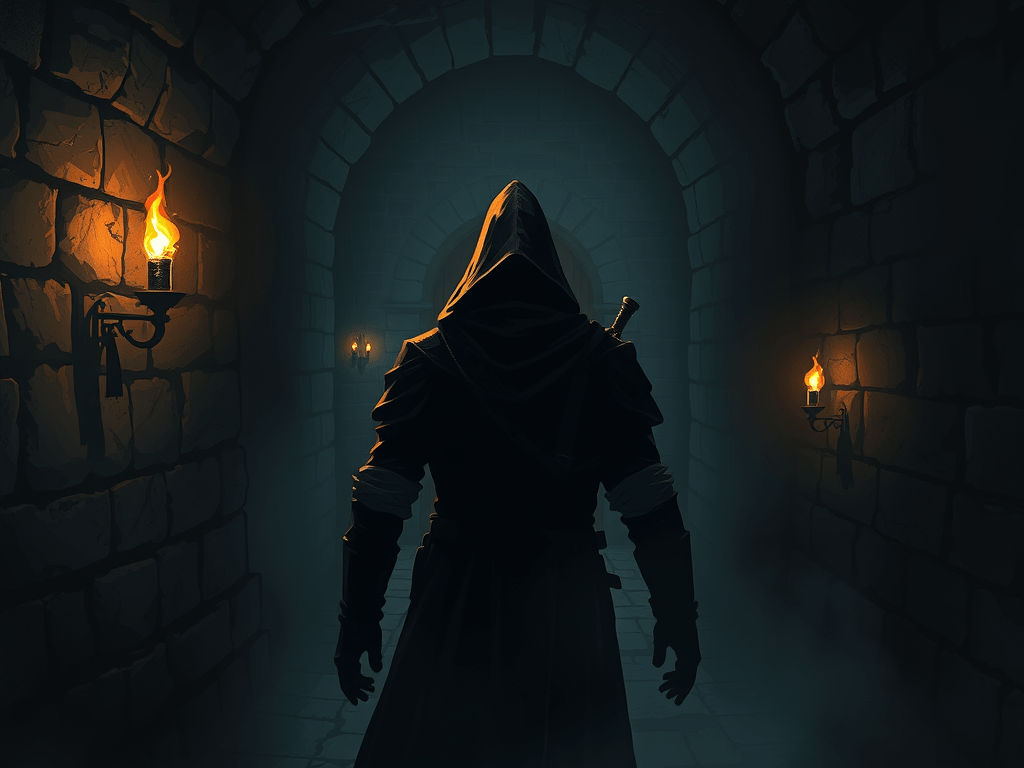
While working on my upcoming one-shot heist, The Alchemist’s Heirloom, I felt the need to add some mechanics to better support stealth-focused play. Many books, movies, and games include scenes where characters sneak in, infiltrate guarded spaces, and quietly dispatch those who might raise the alarm. D&D does not really support this style of play. Once guards need to be dealt with, the game tends to push toward loud traditional combat.
For a heist or infiltration, that creates a problem. Characters built to be subtle, careful, or precise often lack meaningful options once contact is made. I wanted something that allowed players to engage guards when needed, do so quietly, and still keep the tension high, especially in scenarios where open combat would make success unlikely or impossible. The mechanics that follow are meant to support infiltrations, stealth missions, and heists without turning them into all-out brawls bringing the entire armed force down upon the characters or hand-waving the danger away.
While I will be running my own game using the Cypher System, I wanted to include D&D rules as well, given its much larger player base. I’ll be posting the Cypher version of these mechanics as soon as I’ve finished the conversion
Choke Out Mechanics (Stealth Takedowns)
The following rules expand on existing grapple mechanics to support stealth-focused play, infiltrations, and heists. These rules are designed to allow for quiet incapacitation while preserving risk and tension.
Grappling (SRD Reference)
Rules as written
When you take the Attack action, you may replace one attack with an unarmed attack to grapple a creature.
- Make a Strength (Athletics) check against the target’s Armor Class
- On a success, the target is grappled
- The target must be no more than one size larger than you
- You must have a free hand
Grappled:
A grappled creature’s movement is reduced to 0 and it cannot benefit from bonuses to its speed.
The grapple ends if the grappler releases the creature, becomes incapacitated, or the creature is moved out of the grappler’s reach.
Escaping a Grapple:
A grappled creature may use its action to attempt to escape by making a Strength (Athletics) or Dexterity (Acrobatics) check against a DC equal to:
8 + the grappler’s Strength modifier + the grappler’s proficiency bonus
Choke (Special Grapple Attack)
Homebrew
A choke is a special form of grapple intended to restrict breathing or blood circulation rather than inflict damage.
You declare a choke as a special grapple attack made in place of a normal unarmed attack.
You must have both hands free.
Valid Targets
A choke can be attempted only against a creature that:
- Is no more than one size larger than the attacker
- Has a neck or comparable vulnerable anatomy
- Has that anatomy exposed and within reach
A choke cannot be attempted if the neck is fully enclosed by rigid protection such as a sealed helmet, gorget, or similar gear.
Some creatures may be immune to choking if their anatomy does not allow breathing or blood circulation to be meaningfully restricted.
Awareness
If the target is aware of your presence, the choke attack is made at disadvantage.
Choked Condition
A creature successfully seized by a choke gains the Choked condition.
While choked, a creature:
- Is grappled
- Is silenced
All other effects follow the normal rules for grappling.
Silenced
A silenced creature cannot speak, shout, or intentionally produce vocal sounds, and cannot cast spells that require a verbal component.
Involuntary and environmental noise (banging on the walls, breaking a window) may still occur at the DM’s discretion.
Knockout While Choked
A creature held in a continuous choke risks losing consciousness.
A choke is considered continuous as long as the target remains choked without interruption.
If the choke ends, any accumulated progress toward unconsciousness is lost.
Constitution Saving Throws
At the end of each of the creature’s turns, if it:
- Takes an action other than attempting to escape the grapple, or
- Attempts to escape and fails
…the creature must make a Constitution saving throw.
The save DC equals the DC required to escape the grapple.
Unconsciousness
If a creature fails three Constitution saving throws during the same continuous choke:
- It is reduced to 0 hit points
- It becomes unconscious
This unconsciousness lasts 10 minutes, unless ended earlier by magical or medical intervention or DM adjudication.
When this unconsciousness ends, the creature regains the hit points it had immediately before being reduced to 0, up to half its maximum hit points.
Garrotes
A garrote is a tool designed to apply a choke using leverage rather than raw strength, requiring no specialized training and allowing for proficiency bonuses.
A garrote may be purpose-built or improvised from items such as a rope or belt; improvised garrotes follow the normal rules for improvised weapons.
Dexterity-Based Choke
When using a garrote to initiate a choke:
- You may use Dexterity instead of Strength for the choke attack
- You may use Dexterity instead of Strength when setting:
- the grapple escape DC
- the Constitution saving throw DC for the choke
- You must use both hands upon the garrote
Non-Lethal Garrote
A non-lethal garrote made from cloth, leather, or similar material is vulnerable while in use.
- The choked creature may use its action to attack the garrote at disadvantage
- DC: 17
- Hit Points: 12
If the garrote is destroyed, the choke immediately ends.
Lethal Garrote
A lethal garrote is constructed from metal wire or similarly rigid cutting material.
If a creature reduced to 0 hit points by a choke is held with a lethal garrote, the attacker may continue the choke.
While doing so, attacks made to maintain the choke automatically hit and are treated as critical hits.
The target is slain outright or proceeds to death saving throws, at the DM’s discretion.
Interaction with Other Conditions
Incapacitated:
An incapacitated creature cannot attempt to escape a grapple or choke. A choke continues uninterrupted while the target remains incapacitated.
Restrained:
A restrained creature has disadvantage on checks made to escape a grapple or choke. Being restrained does not interrupt an existing choke.
Help Action:
Another creature may use the Help action to grant advantage on the choke attack or on the grappler’s next roll to maintain control. Helping does not interrupt a continuous choke.
GM Guidance: Stealth and Consequences
These rules are meant to support stealth-focused play, not to remove risk or replace combat. A choke allows characters to deal with guards quietly, but it does not guarantee safety or success, especially since the attacker is vulnerable during the act. There are still consequences if a neutralized guard is discovered, fails to report in, or is noticed missing from their post. An unconscious guard may also wake up, attempt to free themselves, or raise the alarm if given the opportunity. If a creature is sufficiently restrained or incapacitated and resistance is no longer meaningful, you may resolve the outcome narratively rather than tracking every neutralized creature.
Attribution and Legal Notice
This work includes material from the System Reference Document 5.2.1 (“SRD 5.2.1”) by Wizards of the Coast LLC, available at https://www.dndbeyond.com/srd. The SRD 5.2.1 is licensed under the Creative Commons Attribution 4.0 International License, available at https://creativecommons.org/licenses/by/4.0/legalcode.
This is an independent, unofficial rules supplement.
Compatible with fifth edition.
 Mason Beck Fiction
Leave a comment